.png)
.svg)

Jaime Prada
We introduce photographer, fashion designer and creative Jaime Prada.
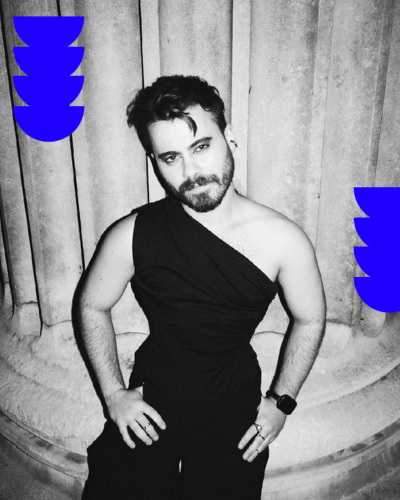
Jaime Prada (they/them) is a photographer, fashion designer, and creative based in Haringey. Born in Spain, Jaime’s work explores queer self-fashioning, migration and cultural memory. Before moving to London, they won the Scottish Portrait Award for Chosen Family, a series celebrating the tenderness and importance of queer communities. Alongside their art practice, Jaime works as an Accessibility and Equality, Diversity, and Inclusion consultant for museums and galleries.
You can see more of Jaime's work at their website and on their Instagram page.
What themes can be found in your work?
As a queer person and a foreign national, these parts of identity are always threaded throughout my work. My work looks at queer self-fashioning, migration, and the ways identity is built through memory, desire, inheritance and survival.
My first creative explorations were in portrait photography, and I think that a lot of the core principles of portraiture still sit at the heart of how I work: I’m drawn to lives that hold more than one story at once. I often return to what people wear, keep, repeat and pass down, and clothes are wonderful examples of this. This is how I started designing clothing: textiles can hold class, labour, ceremony, family history, displacement and aspiration. There are lots of histories hidden in fabric and sewing techniques!

And what sort of work do you want to explore more in the future?
Designing clothes for the subjects of my photographs has pushed further into filmmaking and creative direction - I’m interested in building a whole visual world around a subject. I think about atmosphere, movement, styling, landscape and emotional tone. I still care deeply about portraiture, but I now think as much about sequence and mood as I do about the frame itself. That feels like the path I’m on, and Haringey has become part of the landscape in which that shift is taking shape.
How does Haringey inspire you creatively?
Haringey is full of overlapping textures: languages, shop fronts, domestic spaces, parks, market stalls, and people carrying different versions of home. What I value about Haringey is that no one person or community gets to fix its meaning. The area becomes itself through the people who live here, pass through it, work in it, argue over it, dress themselves within it, and leave traces of their histories behind. That is what gives Haringey such amazing depth! Queer people are part of that life too: not only as keepers of culture, but as its crafters, shaping atmosphere, aesthetics, language and new ways of belonging.

What rituals help you stay creative?
The rituals that keep me creative are simple. Walking. Looking slowly. Letting references gather before forcing them into meaning. Paying attention to materials, environments and small details. Most of the time, the work begins there.
What advice would you give to someone looking to be more creative?
Value your work with critical care. It can be easy to feel pressure to make work that explains your community and culture to the outsider's eye. I spent a long time caught up in that, and it pulled me away from exploring my own voice.
Remember that you do not need to carry the weight of representing everything that you are all at the same time - no one person can do that. I spent too much time trying to stop people from reducing my work to a one-dimensional idea of queer or Hispanic art, and in doing so I found myself recreating the same limiting structures I was trying to escape.
Your work is already part of your culture. It carries traces of where you come from and what has shaped you. Stay attentive to what genuinely moves you, and create from that place.
And lastly: what sort of events would you like to see during Haringey’s London Borough of Culture 2027?
I’d also love to see some of my interests represented! Fashion as an art form, queer and trans-centred work, and access that is built in from the start, including sensory-friendly spaces and disabled-led programming.
Mostly, I’d love to see programming that is genuinely about community building. For me, the strongest
cultural work is the kind that brings people together to learn from each other.


.jpg)

.png)
